
As presented at the AI Recruiting Summit 2026
Economics of an AI-Native Recruitment Agency
The same fees, the same niche, a completely different P&L. First where you could be — then the four things that actually get you there.
By Reyhan Khan · RecruiterGTM
The ideal outcome
Start with the end state: what AI-native actually looks like.
An engine runs the volume work
Sourcing, enrichment, outreach, follow-up, and admin run as systems — every morning, without being chased.
Humans only do the judgement work
You and your team spend the week on clients, candidates, and closing — the part people actually pay recruiters for.
The capability belongs to the company
Playbooks and data sit in systems you own, and nothing walks out the door when someone resigns.
The P&L looks nothing like 60:20:20
Cost base cut by more than half at the same fee income — which is what the rest of this page walks through.
Engine by engine
What each engine does once it's set up.
Sourcing
Candidate long list and shortlist within minutes from a JD — combining warm candidates from your ATS with cold ones from the market.
Business Development
5–7 valuable conversations per week with decision makers who match your ICP.
ContentOS
4–5 content pieces live every week, plus a newsletter landing every 14 days.
OperatorOS
70% less operational and admin headache — reporting, formatting, follow-ups and scheduling run as systems.
TrackingOS
Candidates and clients tracked and nurtured automatically, with a monthly data refresh so the database never goes stale.
The ideal outcome — in numbers
This end state is already showing up in the data.
3.5–4.5x
More likely to report revenue growth
Agencies using AI vs those that aren't — across 2,300 agencies surveyed (Bullhorn GRID 2026).
46%
Cut screening time by half or more
And 55% of firms report candidate-quality KPIs up more than 25% from AI screening alone.
5–6x
EBITDA multiple at exit
Niche AI-enabled agencies vs 4–4.5x for generalists (BDO 2025). More profit, and a higher multiple on every pound of it.
The catch nobody leads with
Most agencies buying AI never reach that outcome.
69%
Have adopted AI tools
Adoption is no longer the bottleneck — nearly everyone has bought something.
18%
Deploy it broadly
Only a fraction get AI past one desk or one use case. Just 8.3% of agency recruiters run 50%+ automation.
88%
Report no real business value
HR leaders seeing no significant value from their AI spend — despite the adoption numbers (Gartner, 2025).
Where most agencies are today
The rule most recruitment agencies are built on: 60 : 20 : 20.
60%
Salaries
Consultants and delivery take 40–45% of NFI; support, admin and directors another 15–20%. Every consultant must bill ~3x their loaded cost.
20%
Overheads
Office, LinkedIn Recruiter, job boards, insurance, marketing, professional fees. Tech and data alone eat 5–15% of placement fees.
20%
Profit — on paper
2026 reality: 15–18% at best; perm desks land 10–18% net, and the industry-wide average after full overheads is just 3–8%.
Let's make it concrete
Meet our scenario agency: $400k a year, team of 3.
Owner + consultant + resourcer, doing 20 placements a year at a $20k average fee. Under 60:20:20 that's $240k salaries, $80k overheads, and $80k profit at best — at 2025's real margins, profit is $48k–80k. Now rebuild it AI-native and compare line by line.
| Annual line item | Old school (owner + consultant + resourcer) | AI-native (owner + 1 Operator + engine) |
|---|---|---|
| Delivery payroll (excl. owner) | ~$100k–130k | ~$45k–60k |
| LinkedIn access | 2 Recruiter seats: $21.6k–30k | 1 Sales Nav seat: ~$1.8k |
| Job boards + CV databases | $5k–12k | ~$0–2k |
| ATS / CRM / tools | $4k–6k | Engine stack: ~$9.9k–10.5k ($829–879/mo) |
| Systems implementation | — (lives in people's heads) | $3k–5k/yr — partner or implementation group |
| Ramp + churn exposure | ~$40k lost productivity per hire · ~$45k per leaver | Engine live in weeks — and it stays when people leave |
| Annual cost base | ~$130k–180k | ~$60k–77k |
Line items sourced (see sources below); combined totals are an illustrative composite — run your own numbers. Pricing checked July 2026.
4–6
of your 20 placements exist only to feed the cost base.
The gap between the two builds is roughly $80k–120k a year— at a $20k average fee, that's 4–6 placements working for your structure instead of you, before any hire ramps or any consultant resigns.
The proposal
Flip 60:20:20 — the other way round.
The old rule puts 60% of your fees into salaries and leaves you 20% if you're lucky. Going forward, build to the inverse.
60%
Profitability
The biggest slice of your fees goes to you — owner pay and profit, not payroll.
20%
Team
A small team doing only the judgement work: clients, candidates, closing.
20%
Systems
The stack, the implementation, and the Operator time that runs the volume work.
On the $400k scenario the AI-native cost base is ~$60k–77k — the flipped model isn't a stretch target; it's roughly what's left when you stop paying for structure.
How you get there
Four pillars — and most agencies only ever do the first.
Buying tools is the easy 25%. The gap between AI-curious and AI-native is the other three.
1 · Systems
The AI-enabled stack
What systems you need and exactly what they cost — before you spend.
2 · Implementation
Set up + wired in
AI implemented for your actual use cases — the step that makes you AI-native.
3 · Training
Ideas into reality
Your team trained well enough to solve new problems with AI on the go.
4 · Maintenance
The Systems Operator
A named owner — and a clear answer to "who do I go to when I hit a roadblock?"
Pillar 1 · Systems
The stack, priced by category — $829–879 a month.
| Category | Tools | Monthly |
|---|---|---|
| AI Orchestration | Claude Code Max — the AI Ops Manager that runs everything below | $99 |
| Data Enrichment Sources | Apollo · Prospeo · PeopleDataLabs ($250) · Pin.com ($180) | $430 |
| Data Research Sources | Apify · Exa | $50 |
| Sequencing | Instantly · HeyReach | $150 |
| Tracking | AI-native Applicant Tracking System | $100–150 |
| Total | ~$9.9k–10.5k a year — for the whole company | $829–879 |
Pricing checked July 2026.
Past a point, you stop buying software — you build it.
With Claude Code as the orchestration layer, small internal tools take hours, not sprints. We run this inside RecruiterGTM today — mini apps replacing paid tools one by one: our own booking flow instead of Calendly, our own content engine instead of Taplio, even our own pipeline views instead of a paid CRM. Each one is a subscription you stop paying, and it works exactly the way your agency does.
You know exactly what systems you need and what they cost — before you spend a pound.
Pillar 2 · Implementation
Tools don't make you AI-native. Implementation does.
1 · Audit
Map the workflows
Where the hours actually go: sourcing, screening, BD, admin. You can't automate what you haven't mapped.
2 · Research + MVP
Prove one use case
Pick the highest-pain workflow, build the smallest version that works, validate it on live roles.
3 · Build
Skills, agents, routines
AI skills for each playbook, agents for each lane, scheduled routines, MCP connections into your ATS, email, calendar and data tools.
4 · Unify
One cockpit
Everything runs from a single unified cockpit — one place to steer sourcing, outreach, content and reporting.
AI implemented for your actual use cases — you're AI-native, not AI-curious with subscriptions.
Pillar 3 · Training
The test: can your team solve a new problem on the go?
Real recruitment use cases built with the stack — each one started as a pain point, not a feature request.
BD signal scans
Funding rounds, job-post spikes, leadership moves → personalised outreach the same day.
Candidate sourcing packs
Job brief in → Boolean strings, target companies, longlist and outreach messages out.
CV formatting
Raw CVs reformatted into client-ready profiles in your house style, in seconds.
Interview prep packs
Company research, likely questions and talking points per candidate, per client.
Client reporting
Weekly pipeline and campaign reports drafted from your ATS data before Monday's call.
Job ads + content
Role ads, LinkedIn posts and newsletter drafts in your voice, ready to review not write.
Your team is trained enough to turn a new pain point into a working system the same week — no vendor required.
Pillar 4 · Maintenance
Every engine needs one named Operator.
Not a committee, not "everyone", not the owner at 11 PM. Three ways to staff the role — the economics work in all three.
Option 1
Run it yourself
Owner-operator. Best for solos who want every point of margin and enjoy the systems side. Budget real learning time in month one.
Option 2
Hire an Operator
A trained GTM Engineer or Ops Manager owns the engine day to day — the $45k–60k payroll line, replacing 2–3 delivery salaries.
Option 3
Partner installs & manages
A partner builds the engine inside your agency, runs it with you, and trains your team on it. Fastest to live; capability transfers to you over time.
When you hit a roadblock, you know exactly who to go to — and it's never 'nobody'.
Recap
What to take back to your own P&L.
Benchmark yourself against 60:20:20
If salaries are over 60% and profit under 20%, you're funding structure, not growth.
Price your data access honestly
Add up Recruiter seats, job boards, and CV databases. Compare it to a $829–879/mo engine stack.
Do all four pillars, not just the first
Systems → Implementation → Training → Maintenance. Tools without the other three are shelfware.
Name your Systems Operator this week
Yourself, a hire, or a partner — but one name. An engine nobody owns is an engine that stops.
Sources
- Recruitment Accountants (UK), 2025–26 — 60:20:20 model, margin compression, 3x billing rule
- Bullhorn GRID 2026 — 2,300 agencies, 3.5–4.5x revenue-growth likelihood, screening stats
- BDO Recruitment M&A Report 2025 — 5–6x vs 4–4.5x EBITDA multiples
- LinkedIn Future of Recruiting 2025 — 20% of recruiter week saved
- APSCo Recruitment Index 2025 · Level CFO Benchmarks · HMRC/PayFit — margins, NI changes
- Gartner (2025) · Deloitte — 88% no-value gap, 40% agentic cancellation forecast, 70% people/process failure share
- Pin.com / Cleanlist · Click Boarding · HR.com · OneUpSales / Pinpoint — seat pricing, ramp cost, replacement cost, placement rates
Run your own numbers. Then come talk to me.
This page gives you the whole model — take it and run it against your own desk. If you want a second pair of eyes on what comes out, message me on LinkedIn. I read every DM.
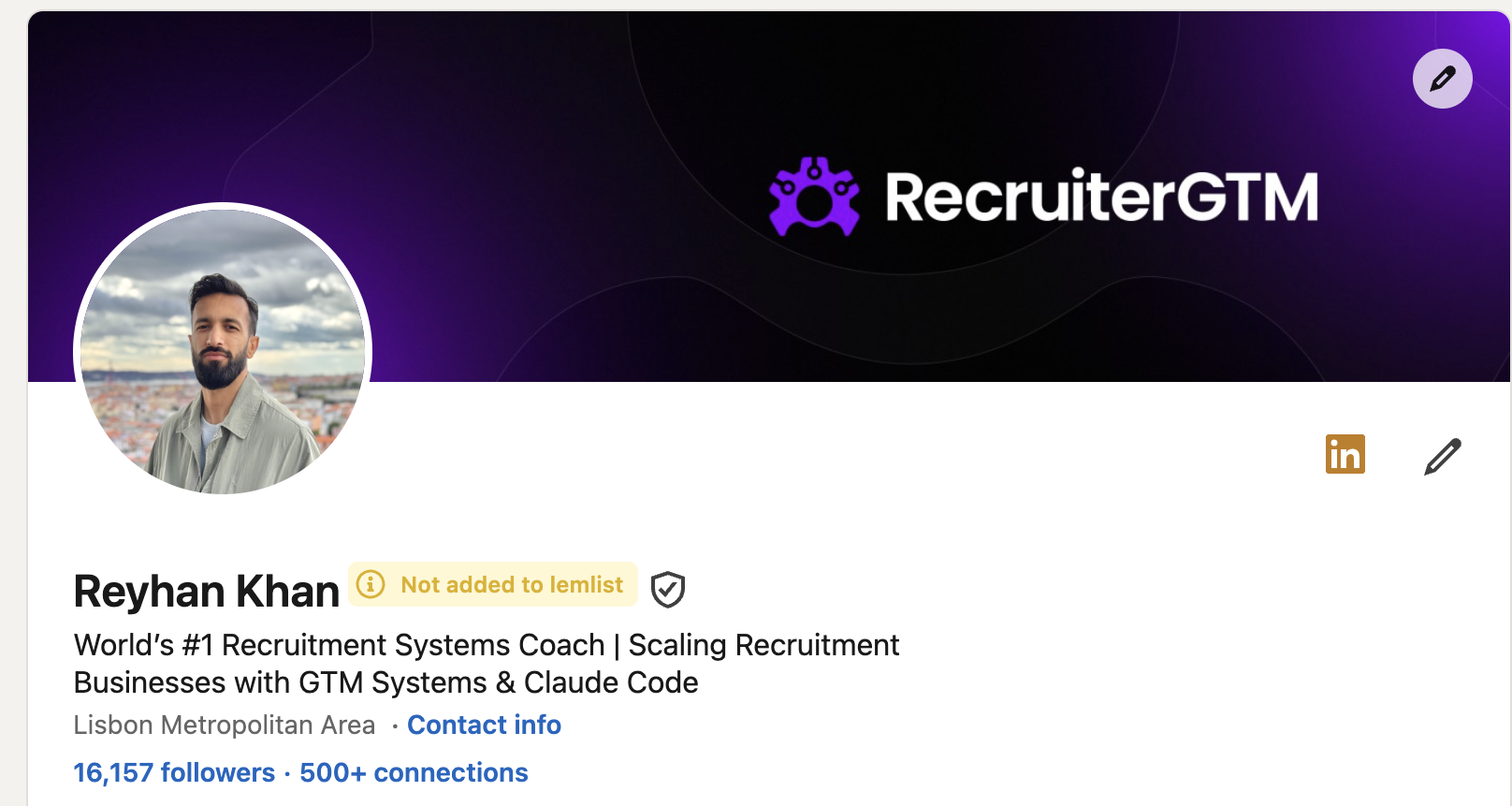
↑ That's me — say hello, tell me what your numbers said.
And when you're ready to build: we install one engine at a time inside recruitment agencies, or you build it with us alongside 80 recruitment founders in the community.
Or subscribe to the newsletter — the deep-dives land there first.